FOOTSTEPS strikes a chord

Last week’s episode of In Their Footsteps struck a chord with many Australian families that have been fractured by the lasting impact of war.

in-their-footsteps-Mark-Hippisley.jpg

It featured 41-year-old Mark Hippisley and his quest to follow in the footsteps of his father, Terry, a Digger who served in the Vietnam War and took part in the Battle of Coral, our biggest battle in what became our longest war.

Terry, or ‘Hippo’ as he’s known to his mates, carried many physical and mental wounds from his war service through his subsequent life, which have seen him estranged from his son and family.

The Hippisley family has a long military history, having served in World War I, World War II and Vietnam. Mark Hippisley tried to follow that tradition and, after being an Air Force Cadet as a child, he went on to full-time RAAF service. But a workplace injury cut short his military career, truncated his life-long ambition and contributed to driving a wedge between him and his father.

Hippo has hidden his lingering pain beneath his larrikin facader. His reserved son, Mark walks in his father’s footsteps in Vietnam, from the battlefields of a rubber plantation to the busy streets of Vung Tau.

In an extraordinary voyage of discovery, Mark finds a deeper understanding of the cost of war and, ultimately, of his father.

IN THEIR FOOTSTEPS GAINS GROUND

The fourth episode of In Their Footsteps, aired on Sunday 29 May 2011, edged ahead in the ratings, up 3% on the previous week, equalling 60 Minutes on 987,000 viewers in an extremely competitive timeslot and evening.

in-their-footsteps-Nathan-Folkes.jpg

The story of 21-year-old Nathan Folkes’ search for his great-great uncle, Salvation Army officer Major Albert Moore who served on the Kokoda Track, was a wonderful exploration of the wartime journey of a man of compassion and courage.

Albert Moore was one of the best loved of all the characters in the Kokoda campaign. He was the subject of one of the great cinematographer Damien Parer’s finest images. Parer captured Albert lighting a cigarette for wounded Digger Lt Val Gardner.

Albert Moore Val Gardner web.jpg

In that image, Parer immortalised Albert Moore’s character and work. Many experts have likened the photograph to Michelangelo’s Pieta, where Mary cradles Christ’s body after the Crucifixion.

Albert Moore won the Diggers’ acclaim for his courage in setting up his tea and coffee stand just behind the frontlines. At Gona, when the Australians confronted a deeply-entrenched Japanese force intent on fighting to the death, Albert silently handed out coffee and chocolate to Diggers literally metres away from the enemy.

Nathan Folkes proudly walked in Albert’s footsteps and gained a powerful insight into the man and his unshakeable belief in peace and God in the midst of war and carnage.

Next week, Footsteps features the story of Billy Brandis, one of our remarkable Z Specials commandos, who fought in the Pacific War in WWII.

IN THEIR FOOTSTEPS BUILDS AUDIENCE

The second episode of IN THEIR FOOTSTEPS consolidated the program’s excellent premiere and increased its viewing audience in Sydney, Melbourne and Adelaide, to total 1.06 million.

in-their-footsteps-Megan-McDonald.jpg

Episode Two featured the short but extraordinary life of RAAF fighter pilot, Tony Boyd, who fought and died at just 22 in the crucial Battle for Malta in the Mediterranean in World War II, as the Allies desperately tried to break the Nazi siege of the island.

Tony Boyd’s great niece, Queensland mother of three, Megan McDonald, shares his love of flying and is training to be a pilot. We joined her as she retraced Tony Boyd’s footsteps and tried to understand what it must have felt like as each day he put his life on the line as a fighter pilot flying Hurricanes and Spitfires against the dominant Luftwaffe in the skies over Malta.

A heady amalgam of historic footage, computed-generated re-creations and breathtaking aerials (in which Megan takes to the skies in a Spitfire) gave us a chilling impression of the thrills and dangers of combat flying.

We learned that Tony Boyd was a heroic pilot - one of the finest of that brave band of young individuals who fought man-to-man above Malta against enormous odds to keep the Luftwaffe at bay. Such was the bravery and resilience of the Maltese people in withstanding the Nazi siege that the entire nation was awarded the George Cross, the civilian equivalent of the Victoria Cross.

Megan McDonald was surprised to find that the people of Malta have never forgotten Tony Boyd and his sacrifice.

Next Sunday’s episode features an enthralling story centred on Gallipoli, in which a father and son head off in search of their forebears, another father and son team, on the tragic Gallipoli peninsula.

In Their Footsteps hits the ground running

In Their Footsteps premiered last Sunday on the Nine Network at 6.30pm with an outstanding ratings performance against very strong opposition.

in-their-footsteps-Julie-Bryce.jpg

Despite facing a two-and-a-half hour special of Dancing With the Stars, Footsteps pulled over a million viewers and ended as the day’s fifth-ranked program overall, eclipsing 60 Minutes, Merlin, Blood Brothers and Hawaii Five-O

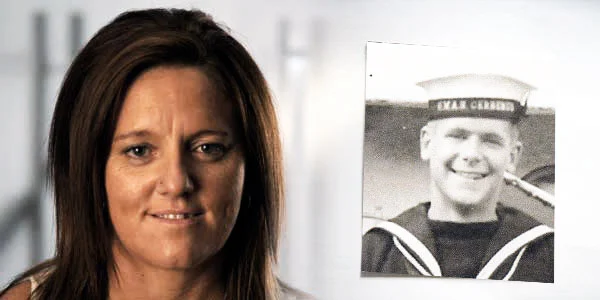
The first episode featured the remarkable story of Tommy Johnson, one of the survivors of the sinking of the HMAS Perth.

Perth Mum, Julie Bryce, had grown up with the photo of her great uncle, a handsome, smiling sailor, but never knew what happened to him. Last Sunday she took us with her as she embarked on an emotional quest to find out what happened to Tommy after the Perth went down in early 1942, taking 353 of his shipmates to the bottom with it.

Tommy and a handful of his mates survived the sinking but they were picked up by Japanese ships and forced to endure the nightmare of the Thai-Burma Railway. When the railway was completed Tommy and his pals were crammed on board one of the ‘hellships’, rusting transports used to take POWs to work as slave labour in Japan.

Once again, Tommy’s ship was torpedoed, this time by an American sub, which mistook it for a Japanese troopship. Once again, Tommy and his mates survived, only to be rescued by the Japanese and taken to Tokyo.

Julie Bryce follows Tommy to the site of the Burma Railway in Thailand, where she walks part of the melancholy trail of death, she visits the site of the Perth’s sinking and lays a wreath, and finally she takes us to Tokyo for the conclusion of her journey of discovery.

Julie hears Tommy’s story through the eyes of one of his best mates, still alive in his 90s. She learns the remarkable sacrifices made by her great uncle and her life is changed by her quest. We are all enriched by following in Tommy Johnson’s footsteps.

This Sunday, we travel to Malta for Tony Boyd’s story. He was one of the bravest of the brave, a fighter pilot in the Battle of Malta in WWII.

Spare a thought for Peter and the others

As the reactions to the death of Osama Bin Laden rebound around the world, spare a moment for those who lives have been irreparably changed by his beliefs and by the actions of his followers.

Peter Hughes was one of them He was one of hundreds holidaying in Bali on the evening of 12 October 2002. He had arrived in Denpasar late that afternoon and had been out for dinner. Just after 11pm he arrived at Paddy’s Irish Pub at Kuta Beach with a group of friends and was waiting for his first shout when he found himself propelled through the air by a massive explosion.

After coming to his senses, Peter helped other victims to find the exit. They staggered out of the firestorm into the street only to be swept almost back inside Paddy’s Pub by a second explosion from the nearby Sari Club.

Peter had instinctively looked left as he exited the bar. Had he looked right he would almost certainly have been killed by the lethal shower of shrapnel from the second blast.

In the shocking first hours of the ensuing media coverage of the tragedy, Peter Hughes’ blistered and grossly swollen face was the image that symbolized the spirit of the Australian victims. Millions of Australians saw him tell rescuers that he was OK and to concentrate on those worse off. We instinctively knew he was gravely injured.

In fact, he was at death’s door. He had burns to almost 60% of his body: full-thickness burns to his arms, legs, stomach and back and serious shrapnel wounds to his stomach and legs. Doctors gave him a 5% chance of survival. They were forced to place him in an induced coma for a fortnight. During that eternity for his family and friends, Peter died three times and was revived each time by his heroic medical team.

He fought and survived this nightmare but ahead lay a world of pain: years of grafts and rehab and long nights of lonely doubts and depression.

But Peter Hughes never gave in. He outlasted the pain and the depression and the doubts and now he has outlasted Osama Bin Laden. More power to him and his spirit.

We’re not as philanthropic as we think!

Most Australians would say that, as a nation, we’re one of the most generous nations in the world.

Sadly, that’s not backed up by the facts. Australia spends just 33 cents out of every $100 in helping the world’s poor. Britain spends 50 cents in every $100. In fact, we rank 16th out of 23 OECD countries in the proportion of overseas aid spent. Yet we were one of the few countries to escape relatively unscathed from the Global Financial Crisis.

Yesterday, one of our most respected leaders in the field of social justice, the head or World Vision, Tim Costello, described Australia’s performance in delivering overseas aid as “shameful”.

He called for both the Federal Government and the Opposition to ensure that our nation adheres to the bipartisan promise of reaching 50 cents per $100 (0.5%) by 2015. He noted that Britain has already reached this goal and will reach 0.7% in two years.

Mr Costello pointed out that, apart from humanitarian motivations, at the very least, “enlightened self interest” should dictate that we do more. We are situated among some of the world’s poorest nations, they play a vital role in our economy, indeed they were the very countries who played a significant role in allowing us to escape the GFC.

Mr Costello named PNG and the Solomons, along with Indonesia as countries we should be doing far more to help.

He referred to a health clinic in PNG where pregnant women were forced to provide their own buckets of water to give birth because sanitation was so lacking. Yet, he added: "You can literally see Australian islands from that health clinic's shore, which says to you, what's the moral significance of this piece of sea?"

In support of his argument, Mr Costello noted that our neighbours, Vanuatu, the Solomon Islands and PNG had more people with malaria than anywhere else in the world. He claims we must strive harder to help these countries to reach the Millennium Development Goals, which have halved the numbers of children dying each day from preventable diseases. 

Let’s hope our government doesn’t use the excuse of having to bring the budget into the black to cut back on our overseas aid. Let’s hope they show some moral courage.

If Britain, which has been so badly affected by the GFC, can not only maintain its 50 cents level but strive for 70 cents, surely we can match or better them.

How can we live in the Lucky Country and do any less?

PNG honours ‘Chief’ Malcolm Fraser

In this autocue age so many political leaders are ‘presenters’ rather than premiers or prime ministers and genuine leaders are as rare as philanthropic bankers.

So it was heartening yesterday to see Papua New Guinea’s High Commissioner to Australia, His Excellency Mr Charles Lepani, honour former Australian Prime Minister Malcolm Fraser for his leadership during PNG’s fledgling days as an independent nation.

Acting on behalf of his nation’s Governor-General, Mr Lepani conferred PNG’s highest honour on Mr Fraser: Grand Companion of the Order of Logohu, which carries the honorary title of Chief.

Mr Lepani explained that logohu is the Motu word for bird of paradise, PNG’s national emblem. He said the award recognised Mr Fraser’s services to PNG, particularly in its early years of independence.

Mr Lepani recalled that he was the head of his country’s planning department at independence and that his country faced a potential financial crisis as it made the transition from colonial control to national independence.

When Mr Fraser assumed the prime ministership in 1975, he was greeted by blunt advice from his Treasury: now that PNG was an independent nation, Australia should treat it as it did other nations and only give it project-based aid, rather than the budgetary support it had previously given.

This prospect caused panic in the PNG government and bureaucracy. They knew they did not have the fiscal and structural depth to withstand such a drastic change in support. The new nation would have been stillborn.

Malcolm Fraser overrode his treasury advice and maintained the budgetary support, allowing PNG time to stabiles and grow. It was a gesture that has lived long in Mr Lepani’s memory.

Speaking after the award, Mr Fraser said he was well aware of the consequences of following the hardline treasury advice. “It wasn’t the only time I rejected treasury advice in those years,” he added with a smile.

Mr Fraser called on PNG and Australia can work together to continue to be a force for good in the Pacific region.

Japan’s POW apology may shed light on Montevideo Maru mystery

It’s taken almost seven decades but yesterday Japan’s Foreign Minister, Seiji Maehara, finally apologised to a small group of former WWII prisoners of war in Tokyo for their treatment at his country’s hands while they were in captivity.

 The long-awaited mea-culpa will give some measure of closure to the dwindling band of surviving veterans who endured and it heightens the prospect of securing Japanese Government assistance in finally solving the 69-year-old mystery of who was aboard the Montevideo Maru, which had its holds chock full of Australian Diggers from Lark Force and civilians when it was unwittingly sunk by an American submarine in 1942.

The Australian POWs who received the apology showed superhuman forgiveness in accepting it. One Thai-Burma Railway survivor, Harold Ramsey, 89, said he believed the apology was “sincere”. Prior to meeting the Japanese Foreign Minister, Mr Ramsey had said: “If you go through life full of hate, the only person you hurt is yourself.”

At the meeting, Mr Maehara also said that Japan would return to Australia historical records of former Australian POWs held by Japan during World War II. Ironically, these records – believed to be an extensive set of index cards - were originally offered to Australia by the Japanese Government in 1953. The Australian Government of the day chose not to take up the offer, saying it did not believe that they would not contain any new information.

On the contrary the Rabaul and Montevideo Maru Society has been asking the Australian Government to intercede with the Japanese Government to seek access to the records because it believes it may unlock the mystery of the fate of the POWs and civilians who perished on the Montevideo Maru.

Australian War Memorial Wins Funding Battle

The Federal Government has bowed to community pressure and committed to an additional $8 million a year funding boost for the Australian War Memorial.

 The decision follows a year-long public campaign by AWM supporters, including Council Chairman, General Peter Cosgrove, who last month said the hallowed institution faced “inexorable decline” and would be forced to close one day a week, cut staff numbers and reduce Anzac Day commemorations.

Prime Minister Gillard announced the funding increase today. It included a one-off payment of $1.7m for the redevelopment of the memorial's WWI galleries and would be in addition to the memorial's regular annual funding of around $38m.

Ms Gillard conceded that the AWM had been forced to dip into capital reserves to pay for daily running costs.

"The new funding will ensure the memorial can adequately respond to increased demands for these events as well as supporting general inquiries, multimedia and educational programs, research centre services and professional historical advice," she said.

AWM director, Steve Gower, only found out about the additional funding this morning. He said it would prevent staff layoffs and would be applied towards the return of open days, exhibition upgrades and more stands for veterans on Anzac day.

It would also mean that at least 20 AWM staff would now keep their jobs.

"I think everyone's aware that cuts in staff were projected over the next few years. So that won't occur,'' he said. "We can have more public activities, plaque dedication programs for units, more activities in the galleries to attract people we want to engage.”

So, once again it took concerted community pressure and potential public embarrassment before the government faced up to its responsibility to adequately fund one of the nation’s most respected institutions.

PNG's future ... in good hands

The next generation of Papua New Guinea’s leaders is waiting in the wings for its chance to guide its nation into the future: they are smart and keen to take up the challenge and they are brimming full of hope and bright promise.

And they’ll now have the chance to expand and develop their leadership skills and potential, thanks to the generosity of one of New Guinea’s ‘old hands’, the late planter, Coast Watcher and philanthropist, Fred P. Archer, who died in 1977 aged 87.

This week, Australia’s High Commissioner to Papua New Guinea, Mr Ian Kemish AM, announced the 2011 Archer Scholars in Port Moresby - a program that offers six final-year PNG tertiary students an unique year-long intensive leadership program (incorporating private mentoring, community development placements, work experience, tuition and boarding support, resource support, and an exchange program to Australia).

Supported by a grant from the estate of the late Fred Palmer, the scholarships are a joint initiative of the Kokoda Track Foundation (a not-for-profit organisation working in the areas of education, health, community development, and microbusiness in PNG) and the Trust Company (one of Australia’s biggest trustees), which manages Fred Archer’s estate.

The Archer Leadership Scholars Program aims to identify and foster the next generation of PNG leaders.

The Foundation called for applications from final-year students, aged between 18 and 35, who are PNG citizens and of PNG heritage from tertiary institutions across the nation and, in this, the first year of the program, it found a wealth of exciting potential leaders.

A shortlist of 14 candidates underwent an intensive interview process and the following six students emerged as the 2011 Archer Scholars:

  • ·       Nellie Hamura (Pacific Adventist University; Master of Arts in Pastoral Ministry; Eastern Highlands)
  • ·       Brendan Pulai (University of PNG; Public Policy Management; East Sepik)
  • ·       Geoffrey Ulsimbi (University of PNG; Environmental Science & Geography; East Sepik)
  • ·       John Pota (University of PNG; Accounting; Manus)
  • ·       Richard Faveve (Pacific Adventist University; Secondary Teaching; Central)
  • ·       Jimmy Mai (Divine Word; PNG Studies/Community Development; East Sepik)

The Archer Leadership Scholarships represent the Kokoda Track Foundation’s first foray out of the Kokoda catchment area. The Foundation has been running its Fuzzy Wuzzy Angel Scholarship program since it began working in PNG in 2003, offering scholarships to bright students attending primary and secondary schools throughout the Track catchment area. This year the Foundation is supporting 313 students on scholarships.

The Archer Scholars program will allow the recipients to extend their leadership skills as they enter the workforce and take other leadership roles in PNG society. It will honour the memory of Fred Archer, who firmly believed that education was the key to Papua New Guineans’ future success, both individually and as a nation.

The son of a drover, Fred Archer served with the AIF in WWI, before moving to New Guinea in 1923 where he became a very successful planter on Bougainville and New Britain.

When the Japanese invaded the Pacific during the Second World War Fred Archer stayed behind and joined the Coast Watchers, hiding behind enemy lines and reporting on their movements.

After the war he rebuilt his shattered plantations to prosperity and created the Bougainville Company, a highly successful sea freight operation.

After he retired, Fred devoted himself to philanthropic work, providing education opportunities for generations of islanders. He paid school fees, attended graduations, sending many local children to the best available schools.

Shortly before he died, Fred formed his company into a charitable trust to be managed in perpetuity with dividends distributed each year to charities in PNG and Australia.